Data Recovery Categories –Hard Drive Failure Symptoms | Disk Failure
Guide | Hard Drive Recovery
In
this article, we explain how many types of data recovery exist and how Data Recovery Lab can deal
with them successfully and recover your lost data. You will learn about different types of hard
drive failure and how hard drive recovery can be successfully done by a skilled
hard drive recovery technician. We will demonstrate how a disk behaves when it
fails and help you identify different symptoms hard disk malfunction and what
you need to do to get your data back.
Recovering data from a faulty or inaccessible hard
disk falls into one of the following categories:In this case, the hard drive is working fine and
there is no apparent sign of failure but the data or the disk partition (data
container) is inaccessible. Data or the disk partition becomes inaccessible
when the drive has been accidentally formatted, or the file table has become
corrupted. This is also applicable if a manufacturers "System
Recovery" disk has been used. (This is the most common mistake people make
thinking that by using the manufacturer’s misleadingly called “system recovery
disk”, they will be able to “recover” their files while in fact by doing so
they delete their files and overwrite the disk partition containing the data.) BIG NOTE: When
you lose data, just switch off the computer and do nothing! You can do more
harm by attempting DIY hard drive
recovery using downloaded software from the internet or using “System
Recovery Disk”. Just turn off the PC and contact a data recovery lab who
specialise in recovering data from your computer. If you continue to use the
machine, then there is a very good possibility that the lost data sectors will
be overwritten by temporary internet files and your data will be lost for ever.
Sometimes hard drives
develop bad sectors either because of a bad read/write head or a bad surface,
making it difficult or impossible to access via any Windows-based operating
system. This can be most commonly diagnosed by the fact that the hard drive is
seen correctly in the BIOS reporting the correct model number and capacity but
the computer freezes when you try to access the drive. In this case, a
sector-by-sector imaging or cloning of the entire drive must be done using a good
and healthy drive. When the sector by sector imaging of the disk is completed, data recovery
specialists will be able to use the healthy
image to recover the data successfully.
3.
Electronic FailureA hard disk whose PCB (Printed Circuit Board) or logic board has failed
or died, falls under the category of electronic failure. This can be most
commonly seen in a dead drive or a hard disk with a burning smell or sometimes
a disk with a clicking noise. There is a wrong assumption that if you find a
perfectly identical PCB and swap it with the faulty one, the dead disk will
start working and the data will become accessible. This is wrong!
All drives have a ROM (Read Only Memory (mainly WD & Seagate) or
NVRAM (IBM/Hitachi) which contains information programmed into it and
soldered onto the PCB. This information has to be exported to a file and then
imported and re-programmed into the donor PCB. This requires specialist hardware
and software costing a few thousands of pounds which can only be done by a
well-established Data Recovery Lab who has invested in the equipment and employs
highly trained data recovery technicians having plenty of expertise in the
field. In some cases, such as Toshiba laptop drives, this ROM data is unique to
the drive and so the original PCB must be repaired to facilitate a successful
data recovery. In the majority of cases,
electronic failure does also cause corruption or media problems such as bad
sectors. As a result, the electronically repaired hard disk must be imaged or
cloned immediately so that the actual logical data recovery
performed thereafter.
Firmware failure happens
when micro codes or what is otherwise known as "firmware" stored in
the Service Area (SA) on the platters of the hard drive, have been damaged or
corrupted. Before the hard disk can start up and become ready for read/write
operation, it needs to access the SA and read the information saved there.
Repair of the corrupted information stored in the SA requires expensive
hardware and software plus years of experience and technical knowledge to
repair of the Service Area using replacement modules from compatible library
drives. One small error can render your drive irrecoverable and completely
inaccessible. Firmware failure can also cause partial media problems such as
bad sectors; therefore in order to achieve a successful data recovery, immediate imaging is essential
after firmware repair has been carried out.
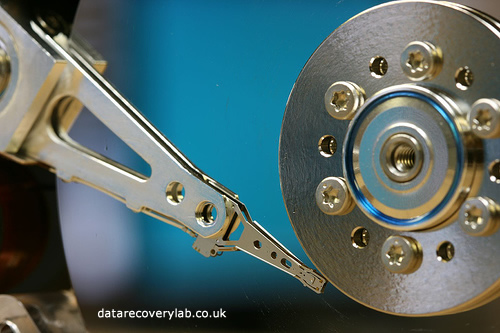
Physical failure can be
defined as read/write head failure, head seizure or motor misalignment in a
hard drive. In this case, a physical fault is preventing the drive to start up.
This can range from a single failed head, to complete head stack or motor
failure. If you have a clicking hard disk, it may mean that the entire head
stack in your hard drive has failed. If your
drive clicks, DO NOT under any circumstances try to
access it, or power it on. Especially if you freeze the hard drive (according
to some misguided old wives tales spread over the internet), you WILL almost
certainly destroy your data for good). Motor failure in a hard drive means that the
drive is not spinning up at all or makes a quiet buzzing sound. In most cases,
a motor failure requires the heads and platters to be removed and placed into a
wood working chassis using special tools. All physically faulty hard disks need
to be dismantled in a dust-free environment and the faulty heads removed
and replaced by a skilled data recovery technician. This operation need a lot
of skill and an untrained IT person cannot do this under any circumstances.
This is like a GP doing heart surgery on his patient in his own surgery on the
examination bed!
Toshiba
- Head failure (clicking), motor
failure (not spinning or rattling noises)
Hitachi
- PCB failure (dead), head failure
(loud clicking)
WD - PCB (dead or clicking), head failure (loud
clicking), SA failure (spinning up but not seen in BIOS)
Seagate
- Head failure (quiet clicking), motor
failure (Not spinning and quiet "Buzzing" sound)
Maxtor
- Firmware failure (seen incorrectly
in BIOS), head failure (clicking)
Samsung
- Head failure (Clicking), PCB (dead)
Sometimes due to
compatibility issues, hard disk replacement heads can be difficult to source.
Fortunately, Data Recovery Lab
has built up a vast library of hard disks since 2001 and if cannot find a donor
disk in its library, it can easily source it through its well-supplied
partners.
If you experience any of
the above symptoms or need hard drive recovery, contact Data Recovery Lab technicians by calling 0207 516 1077. Hard drive recovery
consultation is free and for those business or private customers in London, we
can arrange a free collection in order to provide a FREE data recovery
diagnosis and a free quote.
©Copyright 2012. All
rights reserved for Data Recovery Lab.